My Experience With Malocclusion In Rabbits

Dental problems in rabbits are very common, and many people that take a rabbit with overgrown teeth to the vet will be told that their rabbit’s diet is at fault. My view is that inherited dental problems may be more common in rabbits than previously recognised. And that if your rabbit’s teeth are overgrown, there’s a chance it isn’t your fault at all.

I’ll talk about my own experience with rabbit dental problems and explain how I come to that conclusion below. I’ve also provided some references at the foot of this article, for you to read if you are interested in finding out more about the science behind inherited dental issues in rabbits.
Let’s first talk a bit about how rabbits’ teeth ought to work and what happens when things go wrong.
How rabbit’s teeth work
Unlike cats, dogs, you and me, rabbit’s teeth grow continuously throughout their lives. This enables them to graze constantly without wearing their teeth down to stumps. But it has its disadvantages.
To stop their constantly growing teeth getting too long, the rabbit has to eat fibrous material such as grass and hay. But that’s not all that’s required. Rabbits are full of surprises, and if you look inside your rabbit’s mouth at their front teeth, you’ll find two rows of top teeth, not one. So behind the rabbits’ large front teeth is a second smaller row of teeth.
Your rabbit’s bottom teeth fit snugly (or they should) between these two rows. They sit behind the first row of top teeth and in front of the second. As the rabbit eats, the bottom teeth rub against this second row of top teeth and this rubbing action helps to keep them at the right length.
The rabbit’s large top teeth should therefore overlap the bottom teeth and because the top teeth curve very slightly inwards, they rub on the bottom teeth helping to keep them at a sensible length.
Fun fact: Many people never check their rabbit’s teeth. Rabbits are strong and wriggly and don’t like having their mouths poked about, so most people never go there.
When things go wrong
If the rabbit’s teeth keep growing instead of wearing down, then your rabbit is in big trouble. Overgrown teeth are painful and eventually fatal. If left untreated the rabbit will starve. You could be in trouble too if you decide to treat this rabbit’s teeth and your rabbit is not insured. That’s because this condition may require routine visits to a veterinarian that have the potential to make a big hole in your bank account.
As most people don’t look at their rabbits teeth, the first symptoms they notice are usually in this order
- The rabbit’s coat looks a bit scruffy
- The rabbit looks a bit thin
- The rabbit’s teeth are no longer covered by their lips
The first symptom is often a scruffy coat because the rabbit cannot groom effectively with teeth that are overgrown. If your rabbit’s coat looks a mess don’t just assume that they are moulting. Check their teeth.
The rabbit may be able to eat for quite a few weeks after it starts to neglect its coat, especially if you feed plenty of pellets, but eventually it will have trouble eating these too, and start to lose weight.
Soon the bottom teeth will get so long that they start to protrude out of the rabbit’s mouth. This is the point where most people notice a problem for the first time, and take their rabbit to their veterinarian.

Restoring the rabbit’s teeth to their proper length is tricky, and can be expensive if it requires a general anesthetic. The rabbit’s owner will be given advice on getting the rabbit’s diet in order, in theory to prevent the problem recurring.
In practice, if it’s the rabbit’s incisors (front teeth) that are affected, the teeth may be back to where they were in a few weeks. And that’s because its possible that the problem lies not in the rabbit’s diet, but in the length of their bottom jaw.
Malocclusion of the incisors
Malocclusion means ‘bad alignment or bite’ and refers to the way that the top and bottom teeth fit together. There are two main kinds of malocclusion: acquired, and congenital (meaning that the rabbit is born with the condition). Both kinds of malocclusion can affect both the incisors and the cheek teeth. But it is the incisors I am going to be talking about here.
Acquired malocclusion might occur as the result of a poor diet, or a broken tooth. If a rabbit’s tooth breaks, the opposing tooth may be unable to wear down sufficiently and will start to grow too long.
Congenital malocclusion of the incisors is most often the result of a common recessive gene that causes the rabbit’s lower jaw to be a little bit longer than it should relative to the upper jaw. A condition known as mandibular prognathism.
With experience this condition can sometime be diagnosed in kits as young as three or four weeks, and by six weeks of age it’s usually clear that the teeth are not right.
If you’ve read Part I of my Rabbit Coat Color series you’ll know that rabbit genes come in pairs, one inherited from each parent. And that in simple terms, a gene can be dominant or recessive. Dominant genes over-ride recessive genes and so the rabbit needs two recessive genes in order to display the recessive trait. Usually.
I say usually, because the inherited malocclusion of the front teeth in rabbits has a twist. We’ll go into that in a moment.
For now, let’s just say that if your rabbit inherits the recessive malocclusion gene from both their parents, they are in for a rough time of it. And will likely have a bottom jaw that is very slightly longer than their top jaw. Just like you see in a Bulldog, only less exaggerated.
This tiny difference in length between the upper and lower jaws makes a world of difference to your rabbit because it means that instead of the lower teeth sitting correctly behind the upper teeth, they sit just in front. You can see usually see this in a six week old kit if they have inherited the two recessive genes responsible. Though it doesn’t usually cause them any problems at this age. As they grow, the situation worsens.
Remember I said that the top teeth curve slightly inward so that they rub on the bottom teeth. Well of course if the top teeth are behind the bottom teeth there is nothing for them to rub on. Instead they keep on growing, and curving inwards, until they curve right around and start to grow into the roof of the rabbit’s mouth. Ouch!
Meanwhile the bottom teeth start to curl too, and eventually protrude out of the rabbit’s mouth on one or both sides. To start with you’ll just see the occasional glimpse of a bit of white. Eventually the teeth are permanently exposed.
My first case of malocclusion
The first experience with malocclusion was with a twelve week old white Satin buck. It was summer and he’d recently been vaccinated and was outdoors in a pen, on pasture. I’d been supplementing his grazing with pellets because he didn’t seem to be eating much grass. And had noticed his coat looked rather unkempt.
This little buck was my first Satin baby and I thought he was probably moulting.
It never occurred to me that he might have inherited a dental problem because he had been raised on hay and grass, and because his parents were pedigree Satin rabbits that I had purchased from a breeder who exhibited in rabbit shows. Then one day I picked him up for a closer look because I thought he had some fur caught in his front teeth.
What I thought was fur was one of his incisors. And at twelve weeks old they were already in a bad way. I felt terrible. Both for my ignorance in not checking his teeth when I decided to keep him several weeks earlier. And because he must have been so uncomfortable. He was from my second litter. I had already lost the first litter to rabbit hemorrhagic disease. So I wasn’t doing very well.
In the weeks that followed I set about researching malocclusion in rabbits, bred some more litters and soon discovered that things were not looking good for my herd.
Malocclusion in my rabbit herd
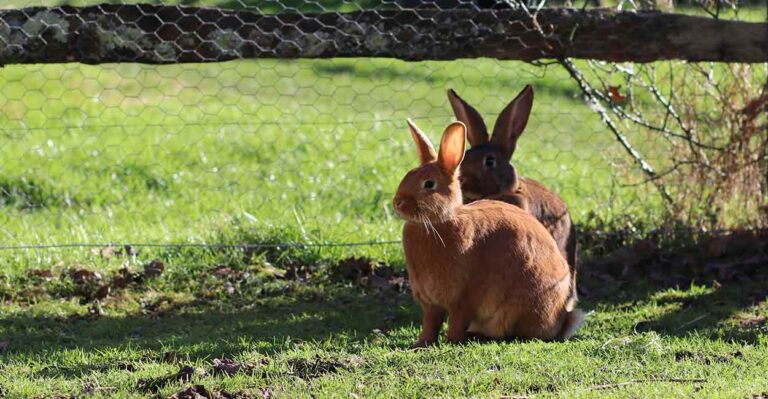
In total I had purchased five pedigree rabbits. A purebred Satin buck and doe. And a trio of beautiful purebred New Zealand Reds.
By the end of the year it was clear that both the Satin Buck and the Satin Doe were carriers of the recessive malocclusion gene that causes the bottom jaw to grow too long. As were the New Zealand Reds. All of them.
Later on I purchased a pedigree Rex buck. He too was a carrier.
The Satin, New Zealand Red and Rex rabbits each came from different breeders in different parts of the country. There was no connection between them. The only thing the breeders had in common was that they all exhibited at rabbit shows. In other words they were presumably knowledgeable, experienced breeders. Hence my assumption that malocclusion would not be an issue in their herds.
So how do I know that all these rabbits are carriers?
Identifying carriers of malocclussion
Rabbits that are carriers of this form of malocclusion have perfectly normal teeth. That’s because they have one dominant gene for normal teeth, and one recessive gene for malocclusion. Remember, the dominant gene overrides, or ‘switches off’ the recessive gene so that it can’t cause problems.
The only way to find out if a rabbit is a carrier is to breed to another carrier. Several times. If you are lucky the problem arises in the first litter and you know what you are dealing with. If you are unlucky it may hide for several litters.
That’s partly because if you mate two carriers together, only 25% of them will be double recessive and develop the disease. Of the rest, 50% will be carriers, and will be able to pass the bad gene onto their offspring. And 25% will be double dominant, clear of the disease, and unable to pass it on to their offspring. It’s this 25% you want to keep.
In theory a litter of eight rabbit kits will contain two that are free from the disease, two that are affected and four carriers. But of course, like eight throws of a dice, it doesn’t always pan out that way. And in practice, I had one carrier that had twenty babies before the disease appeared, and then had several affected babies in a row
When I first realised I had a problem, I listened to what a number of experienced breeders had to say on this topic, and they all advised that I euthanase my rabbits and start again.
That’s because with malocclusion, there’s a nasty sting in the tail. That sting is called incomplete penetrance. And it makes it extra hard to breed this horrible disease out of your herd.
What’s the deal with incomplete penetrance?
This sounds more complicated than it is. Incomplete penetrance means that some of the rabbits that have inherited the double recessive genotype required to cause the disease, don’t get the disease at all. In fact their teeth are perfectly normal. This might sound like a benefit, but it isn’t. Because it enables the disease to hide in plain sight.
Studies have shown what proportion of double recessive rabbits will have normal teeth and its around 19% We refer this as 81% penetrance
In other words about a fifth of affected rabbits will masquerade as either unaffected or carriers. When in fact these rabbits will pass the bad gene onto every single baby they have.
Affected rabbits that have good teeth can only be identified by the increased number of affected babies they have when mated to a carrier. Around 50% of these kits will have the disease. One of my original five rabbits fell into this category. Though of course I didn’t know it at the time.
Removing malocclusion from my herd
Against all good advice I decided to try to breed malocclusion out of my herd, rather than starting over with new rabbits. This is not what I’d recommend for most people. You simply could not do this if you were intending to keep or sell all the babies your rabbits produce.
It also means I have to keep known carriers to test breed my potential breeding stock. Mating a carrier to a clear rabbit will never produce affected kits, and the disease can remain hidden and passed on for generations this way. I want to eradicate it completely from my herd.
Each doe or buck needs to produce more than 20 kits before you can start to be confident that they are not carriers. That’s three to four litters.

It is only a viable option for someone that is harvesting rabbits for food. And that’s because the cost of routine tooth filing for pet or show rabbits is prohibitive. Whereas youngsters destined for the food chain are harvested before their dental issues become uncomfortable.
And what about selling babies that you know or believe to be carriers as pets? Well, to me that is not acceptable, as we have no control over whether new owners will breed from those pets. We would be effectively passing the problem on and causing more heartache down the line.
I made some mistakes with this process. I focused on finding clear does to begin with, when I should have focused on finding clear bucks. Its much quicker to test a buck as he can sire many litters in a short space of time.
When I focused on does, I tried various combinations of matings and kept one doe from each litter. I should have kept all the does in one litter, that would probably have increased my chances of success. As it was, the first six does I kept and bred from all turned out to be carriers.
I am happy to report things are improving! I now have a buck and two does that are probably clear. It’s taking a long time because I want to maintain genetic diversity and good conformation of the heritage breeds in my herd so I can’t just breed for good teeth. But we are getting there.
Why do I think most problems with rabbits teeth are inherited?
I said at the beginning that I think more rabbit dental issues may be inherited rather than caused by diet, than is currently recognized. At least, in the UK.
In the German study mentioned below by M Berger, over 96% of the 82 rabbits included had a good diet that included free access to hay and daily fresh vegetables. Yet 33% of them had dental problems. One third of those on the front teeth, two thirds on the cheek teeth.
I listen to what rabbit breeders around the world are saying and there are many breeders that do not feed hay (or grass) at all but that have herds free from malocclusion. I’m not saying hay doesn’t matter, it does! Check out my feeding article to find out why. I’m simply saying lack of hay alone may not be enough to cause malocclusion in a rabbit that does not carry the relevant genetic information that predisposes them to the disease.
My own experience of purchasing rabbits from three different breeders and ending up with carriers of incisor malocclusion in every group could be a coincidence. But added to the above, it becomes more thought provoking.
How you can avoid malocclusion?
In my view, avoiding this condition really does begin with picking your rabbit carefully. Asking a rabbit breeder the right questions helps. “Have you ever had a rabbit in your herd develop malocclusion?” is a good place to start “ What steps did you take to eradicate it?” if the answer is yes.
Of course a breeder could lie, but most won’t if asked directly. I never asked these questions with my original five rabbits, but I would now.
When you buy a baby rabbit, if you do nothing else, check their teeth! This isn’t easy, so if you are inexperienced, get the breeder or pet store assistant to show you the rabbits teeth. Look at them carefully. The top teeth must clearly overlap the bottom teeth. If they do not, then run away!
Not an avoidance strategy, but this will minimize your losses – when you get your rabbit home, consider taking out pet insurance, making sure that it covers dental problems too.
I hope you never have to deal with this condition, but if you have, I’m always interested in hearing other viewpoints and experiences. Please feel free to comment below, or join my email list and reply to me there.
References
Dental diseases in rabbits: malocclusion and their consequences, M. Berger, HuVeta, 2022
Malocclusion in Oryctolagus cuniculus: causes, diagnosis, prevention, treatment. Proorocu et al. Rabbit Genetics, 2022
The Biology Of The Laboratory Rabbit. Weisbroth et al. Academic Press, 1974
Free Rabbit Updates!
Get rabbit tips, news, reviews and the latest from Just A Few Rabbits, delivered to your inbox