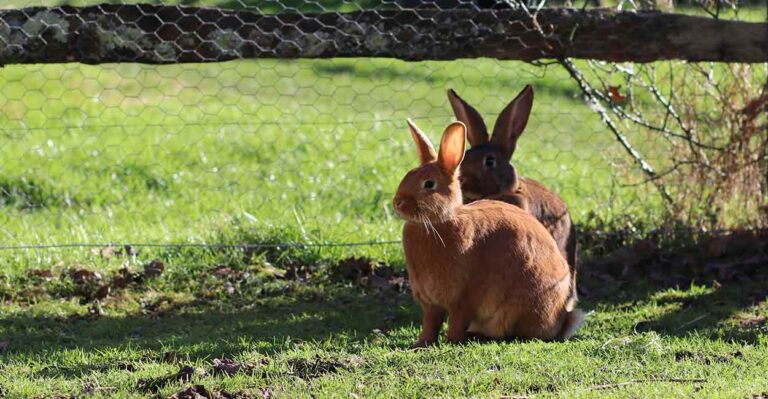
Newborn Baby Rabbits – What To Expect

I have a new litter of rabbits at the moment, and I thought it would be nice to share them with you. Baby rabbits are called kits. And most are born after just 31 days of pregnancy. I’ve added a video below so you can see how lively they are!
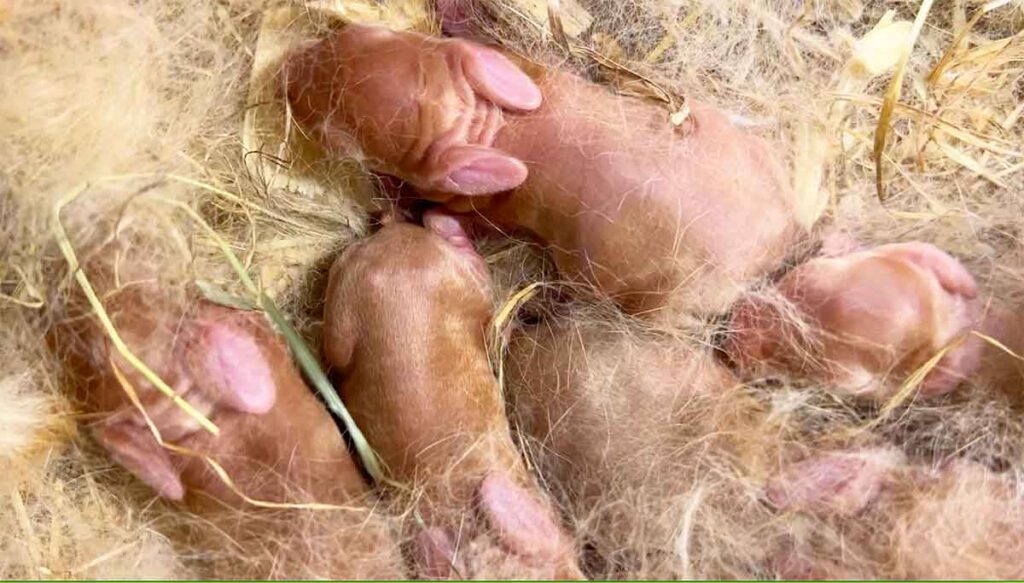
Like puppies and kittens, newborn rabbits are extremely vulnerable and will be dependent on their mother for the next few weeks.
Kits are usually born without much fur, but their coat grows in rapidly in the first few days.
If the babies are overdue then they may have fur on day one like the babies in the video below. These are New Zealand Red kits, about four hours old, and they were born on day 32, so a day late.
Normally a newborn red kit is pink with just a suggestion or haze of red fur, but in these, the red fur is already obvious.
Are baby rabbits helpless?
You can see how lively the nine newborn rabbits in my video are. And although their eyes and ears are closed at birth, rabbit kits are not entirely helpless.
They can wriggle vigorously and grab with their mouths. And if you open up a nest full of newborn rabbits they will leap about in the hopes of latching onto a source of milk.
The rabbit’s nest
The mother rabbit made this nest of hay a couple of weeks ago, and pulled fur from her chest and flanks to make a warm blanket for her babies at the time of birth.
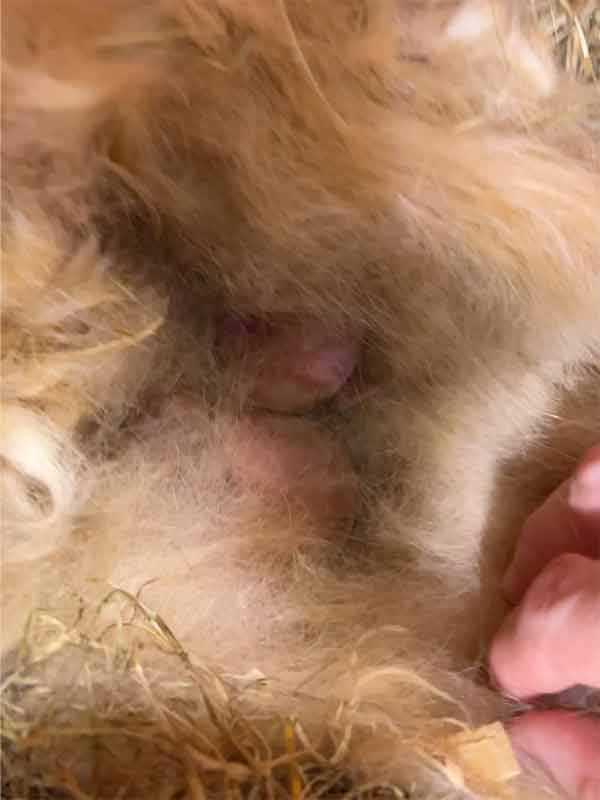
I’ve opened up the nest to check on these newborns, so you can see the babies inside, but very often all you will see when you look down on the rabbit nest from above, is a pile of fur.
If you stand and watch for a moment, you’ll see that the pile of fur is moving!
Is it ok to open the nest?
If you have a relationship of trust with your rabbit, it’s fine to check on her babies. In fact, its a good thing, and mother rabbits don’t harm their babies when you do this.
In a large litter there is often a stillborn kit or the mother may have missed clearing up a placenta or two. You need to remove these, and any bits of very wet hay, or they will attract flies.
By a relationship of trust, I mean that the rabbit is not afraid of you, and doesn’t run and hide when you go to her pen. But instead comes to see what treat you have brought for her today.
If you try to nest check a very nervous rabbit, they may panic, and in their panic they may jump on their babies, so it’s probably best to remove them first.
The nest check
In this case, the mother is Primrose, a very calm and trusting New Zealand Red doe. This is her second litter and she’s happy to catch up on a bit of breakfast, while I check over her babies.
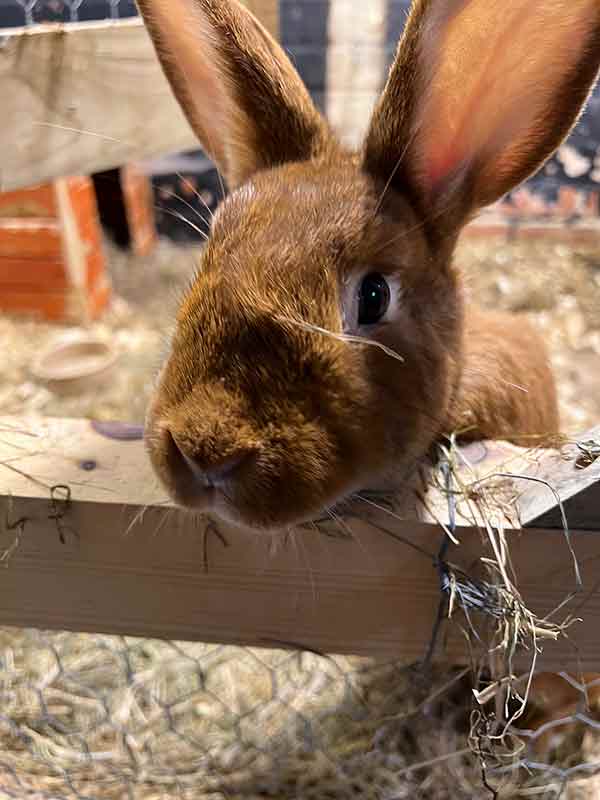
With some does, they may get a bit agitated when you open the nest and in that case I would pop the mamma rabbit into a pet carrier, while I make a quick check on her babies
When I check on rabbit babies, I put some hay into a small cardboard box with some of the mother’s fur, and place the babies into this temporary nest one at a time.
In this case I removed a placenta and some messy hay, then tucked them all back into bed. Primrose had nine healthy kits and there were no problems.
Is my rabbit feeding her babies?
A lot of people worry that their rabbit isn’t feeding the babies. This is almost never the case.
Rabbits have a very different feeding schedule from cats and dogs.
They visit the babies just once or twice a day. Usually early in the morning and later in the evening. Sometimes an inexperienced doe will rush in and feed the babies again after your nest check. But most won’t bother.
Rabbit kits feed lying on their backs. The mother stands over the nest and the babies jump up to latch onto her. Newborn babies can jump surprisingly high!
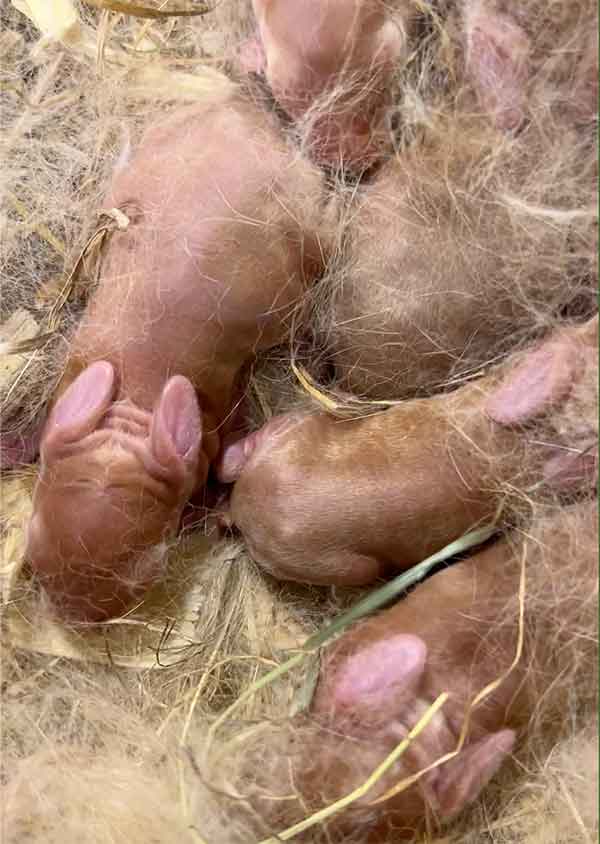
Check out the photo above to see what a rabbit with a full tummy looks like. You can see that the baby on the left has a smooth fat tummy that’s much wider than it’s head! So Primrose had already fed her babies before I checked them.
Kits that are not getting milk look thin with wrinkly tummies
Rabbits feed their babies extremely fast. They are in the nest for less than ten minutes or so, and the babies get all they need in this time.
You really need to trust your doe on this. Her milk is very rich and she will nurse the kits often enough for most of them to thrive.
Watch out for stray babies
Occasionally a baby rabbit will hold so tightly onto the doe that they are pulled out of the nest when she leaves. A kindling box with high sides or a nest box with a lip helps to reduce this risk but it can still happen.
In the first week of life, kits die quite quickly if they get cold. So it’s important to check the area around the nest a few times each day, and make sure there are no babies missing from it.
Its also important to warm up any cold, still, babies that have strayed from the nest before pronouncing them dead. There’s an old rabbit keepers saying “There’s no such thing as a cold, dead baby rabbit”. It’s surprising how dead a cold kit can look only to start wriggling around when they have been warmed up again.
Why doesn’t my rabbit stay in the nest?
Rabbit maternal behavior, the brief and infrequent feeds, and the fact that the mother rabbit doesn’t hang out with her babies all day, is mostly about evading predators. And partly about the way that rabbits feed.
An adult rabbit’s defence against predators is speed. For a baby rabbit their best defence lies in not being discovered. A mother rabbit traipsing back and forth to feed babies every couple of hours would soon give away the location of her nest. So it makes sense for her to minimize visits to her babies.
And of course a rabbit cannot consume an entire day’s worth of food in ten minutes like a dog or cat can. In the wild there’s no-one to bring her bowls of food or racks of hay. So she cannot afford to lay around with her babies all day. She needs to keep foraging and grazing. And its this instinct that our domestic rabbits have inherited from their wild ancestors
What happens next?
For the next two weeks the babies will stay in the nest, drinking milk and getting plump and furry. You don’t need to do anything for them except keep Mamma rabbit happy and well fed with a plentiful water supply.
The kits will push the fur to one side if they are too hot, and snuggle under it if they are cold.
Towards the end of that two weeks the kits will open their eyes, start to nibble hay, and begin to make their first tentative explorations out of the nest box.
That’s a story for another day! Check back soon to see how our litter grows!
Free Rabbit Updates!
Get rabbit tips, news, reviews and the latest from Just A Few Rabbits, delivered to your inbox