The Right Way To Feed A Rabbit

I’m not normally a big fan of laying down the law about ‘the right way’. But when it comes to feeding a rabbit, there really is a right way. And the wrong way can lead to big problems and a very sick bunny.

Traditionally, if you bought a rabbit from a pet store, you’d also be sold a wooden hutch, a packet of rabbit food, some sawdust, a water bottle, and if your rabbit was lucky, some hay.
Most people sprinkle sawdust on the floor of the hutch and stuff the nesting box full of hay, because that’s where they expect the rabbit to sleep.
Then they open the packet of rabbit food, which closely resembles their breakfast muesli, and pour a ton of it into the bowl. They fill up the water bottle, attach it to the hutch, and place the rabbit and their bowl inside their new home. Job done.
What Happens Next?
Instead of snuggling down into their nice new nesting box, the rabbit eats a bit of its bed, poops on the rest, and sleeps out on the bare wooden floor of the main part of the hutch after kicking the sawdust out of the way.
A lot of people abandon giving the rabbit hay because the rabbit clearly isn’t sleeping in it, doesn’t seem to eat much and just makes a mess with it.
But rather like the ponies that you see in paddocks in the countryside, rabbits are not animals that nest. The exception being the nest that a mother rabbit makes for her babies. So your rabbit will never sleep in a nest. The hay is still important though, and we’ll talk about that in a minute.

The newly installed rabbit also picks out bits of their breakfast and leaves large amounts of it in the bowl, for you to give to the wild birds or tip in the trash. While the rabbit waits for a fresh bowl to arrive.
The first thing to fix is that muesli, then we’ll talk about hay.
No More Muesli!
Just like those ponies we mentioned above, rabbits are grazing animals. It’s not natural for them to eat muesli. It’s not that there’s anything wrong with the mixture you are sold. Rabbit muesli type is a mix of nutritious cereals and legumes. In the packet, these are nicely balanced to provide your rabbit with a healthy diet.
But, and it’s a big but, I’ve yet to meet a rabbit that ate all the components of the muesli. They pick out the bits they like best, usually the sweetest bits, and leave the rest. Which of course unbalances the nutrients they are getting.
This means you need to ditch the muesli, and get your rabbits some pelleted food. With quality rabbit pellets, each pellet is pretty much identical and the rabbit can’t pick and choose the sweetest bits. So they get a balanced diet.
The amount of pellets your rabbit needs day is surprisingly small, and it’s entirely possible to keep your rabbit healthy without any pelleted food (or muesli) at all. We’ll look at that in a moment too.
Pellets Are Not Enough
Many dog and cat owners are used to opening a packet of dried, pelleted food and pouring it into a pet bowl. And for that dried food to provide all the nutrients that their pet will need for that day. And many people expect to be able to do this for their rabbits.

Rabbit digestive systems are rather different and the “just open a packet and pour” method doesn’t work so well for them. In fact rabbits have more in common with the ponies we keep talking about, than they do with any of your other pets. Check out The Pony In Your Hutch to dig deeper into this interesting topic!
What rabbits need above all else is either growing grass, or hay. Or a combination of the two.
Feeding Hay or Growing Grass to Rabbits
I talk about hay quite a lot! And that’s because hay should comprise the majority of your rabbit’s diet. The exception would be if you are able to graze your rabbits on pasture as we do. Though in many regions you’ll still need to supplement with hay in the winter when the grass stops growing.
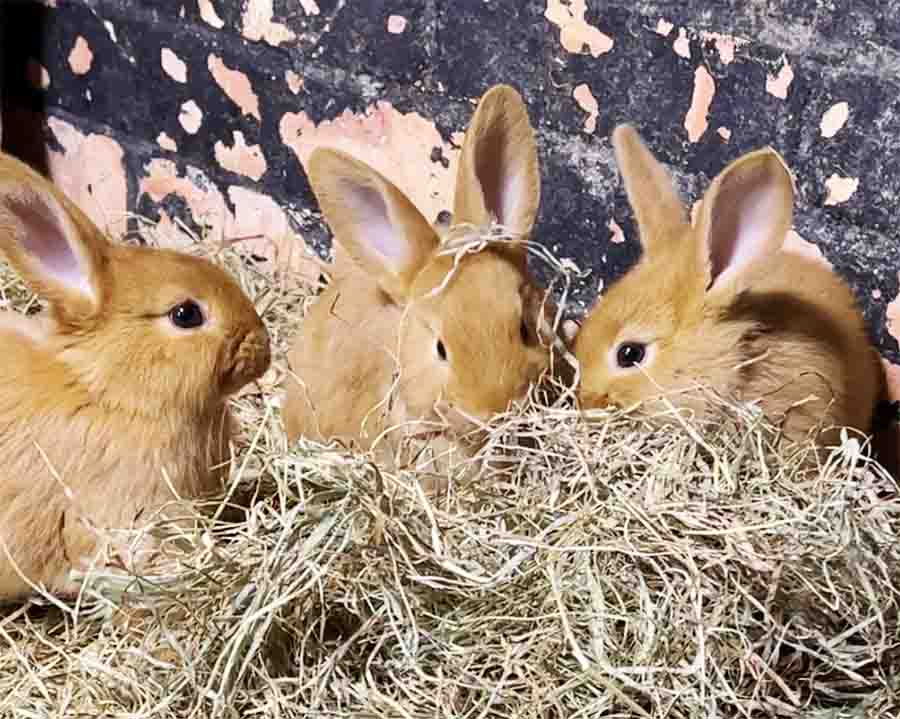
As most people keep their rabbits indoors or in a pen of some kind, it’s hay that they need all year round. And hay needs to be at least 75% of an indoor or caged rabbit’s diet.
That’s right: 75% !
Fun Fact: Rabbits Can Survive On Hay Alone
Did you know that rabbits can actually survive and thrive on good quality hay alone? Our rabbits thrive on hay during the winter and pasture during the summer, with just tiny quantities of pellets as a treat for them when they return to the barn at night.
Before you rush for the mower, you can’t substitute pastured grazing with grass clippings. When you cut a blade of grass from its growing roots it starts to break down and ferment. A handful of freshly pulled grass is okay, but grass clippings in any quantity are harmful to rabbits.
If you have a lawn or other area of growing grass in your yard or garden, you can buy a secure outdoor run where your rabbits can spend part of their day. Introduce rabbits to growing grass very slowly. Just five minutes grazing the first day, to accustom their digestion to the new food and avoid diarrhoea.
Good hay contains everything a rabbit needs in terms of nutrients but also has two other important roles. Hay helps to keep your rabbits teeth and intestinal tract in good working order. Let’s take the teeth part first
Keeping Teeth Trim
Unlike human teeth, rabbit teeth grow continuously. This is to enable them to constantly eat vegetation which would otherwise wear their teeth down into little stumps!
The downside is, that if a rabbit does not have access to the grinding action of eating fibrous food, there’s a risk that their teeth could grow too long. This would cause them problems that require regular expensive veterinary treatment.
Access to a plentiful supply of hay, as a major part of their diet, helps to ensure that your rabbit’s teeth are kept nice and trim! But that’s not the most important role that hay plays in a rabbit’s life.
Gut Health
Just as the rabbit’s teeth are adapted to eating fibrous material, so is their gut. The rabbit’s digestive tract is designed to digest large quantities of cellulose – that’s the tough fibre found in grass, hay and some other plant material.
The rabbit’s gut flora – the microscopic organisms that live there – are closely linked to their general well being. And disruptions to the gut flora can make a rabbit very sick. That means you need to keep the hay coming!
How Much Hay Do Rabbits Need?
Many experts recommend that hay makes up at least three quarters of the rabbits total food intake each day. A good rule of thumb is that the bundle of hay you provide, should be a similar size to the rabbit.
But what if no-one seems to have mentioned this important fact to your rabbit!
What if your rabbit won’t eat hay at all?
My Rabbit Won’t Eat Hay
A rabbit may refuse to eat hay for a number of reasons, including habit, and over provision of alternatives.
We all know that a plate full of healthy steamed vegetables, or a nice colourful mixed salad, is better for us than bread or candy. But when faced with a nice fresh bagel, or a tray full of cup cakes, then it’s easy to be tempted to make the less healthy choice.
Rabbits are just as susceptible to temptation as we are. And a bowl full of tasty rabbit mix or pellets is simply easier and more appealing than hay to many bunnies.
If your bunny won’t eat hay, then it’s quite likely you are feeding too much food in the form of easy to eat pellets. Try cutting back on pellets a little, to encourage your rabbits to snack on their hay. This may not work unless you make an effort to make the hay more appealing. The main way to do that is to offer nice fresh hay each day.
Freshness
It’s annoying, but rabbits like their hay fresh. Very fresh. A common reason for refusing hay is that the hay on offer is stale or not very appealing. Or is simply the hay that was there yesterday.
It makes no sense to us, and it may look and smell fine, but if the hay has been lying around in their pen for more than a few hours, many rabbits won’t touch it.
There are tips and tricks you can use. Setting up a hay rack of some kind, and filling it with fresh hay each morning and evening is a good start. Sometimes just fluffing the hay up with your fingers will revive the rabbit’s interest in in.
All sources of hay are not equal. Hay comes in different types. Hay sold online for rabbits and guinea pigs is often ‘meadow hay’. The best hay for rabbits is Timothy hay, which may be a little more expensive. If you offer different types of hay, you should find out quite quickly which your rabbit prefers.
Add Vegetables to the Hay
Another trick is to add a few little pieces of vegetable matter into the hay rack. A dandelion leaf, a bit of carrot peel, etc. That should encourage the rabbit to burrow about in their hay and hopefully snack on some as they go.
In fact, after hay (or grass), your rabbit’s next source of food will be green vegetables or leaves.
You don’t have to spend hours in the wilderness collecting food for your rabbit (though if you can spare the time foraging for your rabbit is very rewarding). The peelings from many of your own veggies, and veggies that are easily available in your local store, are fine. But you do have to introduce vegetables to rabbits very gradually if they have not been exposed to them before, in order to avoid upset tummies.
Rules to Avoid Rabbit Diarrhoea
Rabbits are herbivores. Think of your rabbit as a strict vegan, and never give your rabbit any meat or dairy products of any kind, these foods will make your rabbit ill. Diarrhoea can be very dangerous to rabbits, so it’s important to follow four simple rules that avoid upset tummies.
- Vegan all the way – think dark green leaves
- Make any changes in food gradually
- Feed predominantly hay, especially when the rabbit is stressed
- Stick to a few safe vegetables until your knowledge expands
Change Rabbit Food Gradually
When you first bring your rabbit home, feeding is very easy. For the first 48 hours, just give your rabbit lots of nice fresh hay, and a little of whatever dry food they were being fed on previously. We’ll look at exactly how much dry food to give in a moment.
After hay, fresh greens should be the biggest part of your rabbit’s diet. But these must be introduced gradually as if your rabbit isn’t used to them, too much can cause diarrhorea. I know you are in a hurry to share all those lovely vegetable peelings that you have been throwing away, but take your time.
Introducing Vegetables
Introduce one safe veggie at a time. When you bring a new rabbit home, I suggest you give a piece of cabbage or bok choy leaf, not much bigger than your thumbnail, or at most 1 X 1 inch, on day 1. Increase the quantities each day, over the next week.
On day 2 add a thumbnail size piece of the second veggie, and increase in the same way. Here are a few safe veggies to start you off. We’ll give you a bigger list below.
Safe Veggies for Rabbits
Some plants are toxic to rabbits and some, such as iceberg lettuce can cause diarrhoea. But you can share the following basic green veg that many of us have in our kitchens, with your rabbit
- Cabbage
- Broccoli leaves
- Bok choy
- Celery leaves
With greens, focus on the leaves rather than the stalks. A little bit of stalk is okay, but in general, the stalks are better off going in your compost heap than into your bunny where they can cause excessive wind.

Root Vegetables
You can also feed small quantities of some root vegetables such as carrots and parsnips, as treats. They are very sweet and more of a treat than a necessity, so not too much of these unless your rabbit needs to put on weight.
Herbs
Rabbits can also eat some common herbs and leaves such as
- Basil
- Raspberry leaves
- Dandelion leaves
- Parsley
And if you have trees or shrubs in your yard, some of those are suitable for rabbits too, for example
- Apple
- Birch
- Rose
- Willow
Remember, many common plants are not safe, so do your research. And while you are finding out about all the different foods that rabbits need, and getting to know your new rabbit, remember the mainstay of your rabbits diet will be hay.
Continuous Supply
Rabbits need to eat pretty much continuously. If you are used to keeping carnivorous pets like cats and dogs, you are probably familiar with feeding at intervals with long gaps in between. Or with starving a pet for 24 hours if they have an upset stomach, just to allow their gut to recover.

It’s important to treat your rabbit very differently.
With rabbits, removing food for more than a few hours can be dangerous. Their whole system is designed to have fibrous material constantly moving through it. And hay is a vital part of that process.
Feeding Pellets
I feed single and pairs of rabbits in a standard 5 inch ceramic rabbit bowl. Most people start by filling a bowl like this and giving it to their rabbit.

Many experts now believe this is too much, and restrict rabbits to three or four ounces of pellets per day. That’s less than half this bowl full for a single rabbit. About half a cup.
Feeding Schedule and Timings
I provide fresh hay and water, morning and evening to indoor rabbits, and feed pellets and vegetables mid-morning.
But it isn’t critical what time you feed your rabbits. If your rabbits live outdoors, feeding morning and evening is a good habit to get into, simply because its and opportunity to check on your rabbits and make sure they are okay.
Some rabbits seem to prefer to eat their pellets early in the morning, in the evening, and during the night. They then like to rest up and munch on hay and on their cecotrophs, during the day .
Pasture Fed Rabbits
If you are putting your rabbit out to graze for a few hours each day, then they will enjoy their grazing more in the morning and evening.
If you leave them out all day, make sure that they have somewhere dry and sheltered to get away from wind, sun and heavy rain.
Pasture fed rabbits or rabbits grazing outdoors also need to be protected from predators and from local rabbit diseases. Ask your veterinarian about the appropriate vaccinations in your area.
Here are a few of the many safe foods that you can give your rabbits:
Herbs
- Cilantro
- Parsley
- Celery
- Cucumber
- Chicory
- Zuccini
- Rocket
- Spinach
- Watercress
- Spring Greens
- Carrot tops
Trees / shrubs
- Sycamore
- Ash
- Hazel
- Pear
- Blackcurrant
- Aspen
- Blackberry
- Hawthorn
There are a lot of plants that are toxic to rabbits, so if in doubt, don’t feed it to them. Here are some useful resources
- Plants toxic to rabbits USA – FirstVets
- Plants toxic to rabbits UK – Rabbit Welfare Association
Drinking Water
Another important factor in keeping your rabbit’s gut healthy is water. My adult rabbits drink around half a litre of water a day.
Rabbits can easily get dehydrated. Never let their water bottle run out, and check that the water comes out of their drinker fairly easily, or the rabbit may limit how much they drink.
A rabbit that has been raised on water in a trough may resist drinking enough from a bottle, so if necessary provide an additional clean bowl of water each day.
Rabbit have been rather misunderstood over the years. But their needs are fairly simple. If you remember that your rabbit is a leaf eater and focus on hay rather than dried food from a box as their staple diet, with some nice fresh veg added in, you won’t go far wrong.
Does your rabbit have a favorite vegetable? Let us know in the comments below!
Free Rabbit Updates!
Get rabbit tips, news, reviews and the latest from Just A Few Rabbits, delivered to your inbox