
Colony Vs Cage – Which Is Best For Rabbits?

It might seem that a colony is the obvious choice here. But I think it’s important that we take a step back and think about that choice. Because what makes a person happy might not necessarily be what makes a rabbit happy.

It’s also worth considering that not all colonies are equal. And that there are some downsides to colony life. Let’s look at those first.
Fighting Between Rabbits
Proponents of keeping rabbits in cages like to point out that rabbit colonies are not all sweetness and light. And they are right. Rabbits are actually quite quarrelsome. Especially does.
There is a bit of chasing and bossing each other about in the stable yard where our rabbits live. Though I never see massive fights of the kind that you get if you put a female rabbit over a certain age into another adult female rabbits pen.
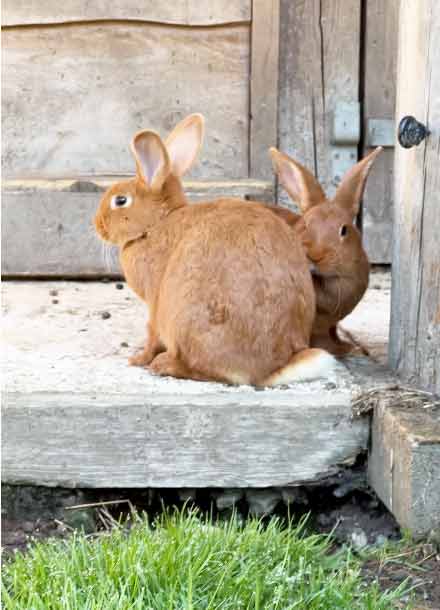
As an aside, rabbit fights can be dramatic. I once mistakenly thought two fifteen week old female rabbits were ready to get along (they had been living in adjacent pens for the previous month) and I was very wrong. So I do know what a real rabbit fight looks like. Breaking it up requires speed and gloves!
However, while some of the females in our stable yard colony do harass the others at times, and fur does sometimes fly, blood is never drawn.
As an update, I’m actually seeing this kind of interaction or a bit of chasing, less now. Maybe one or two times a month. For most of the time, the colony is peaceful, so I think this downside is fairly minor, provided there is enough space for the rabbits you have in your pen.
Disease
Another argument against colony raised rabbits is the risk of disease when rabbits are in contact with soil where their droppings have been deposited.
In wire cages, the rabbit droppings fall through the wire bottoms and are disposed of.
There’s no question that colony raised rabbits do come into contact with their own droppings, as do all wild rabbits. Only an entirely nomadic animal could avoid that entirely. And the main risk to rabbits from that contact is a disease called coccidiosis.
I address this in a lot more detail in my article on coccidiosis. In our rabbitry we choose to avoid this issue by feeding a small amount of medicated pellets. Rather than by caging our rabbits. And I talk about that choice here: Coccidiosis In Rabbits
Some other downsides to colony life as opposed to cage life, such as pregnancy and predation, can be avoided.
Multiple Litters
We keep our male rabbits separately from the colony. That’s because rabbits naturally re-breed immediately after giving birth. Which would mean a litter of babies every four weeks. Which is not what we want.
We also like to choose which buck mates with which doe, in order to maintain a good genetic diversity and to keep our heritage rabbit breeds true to type. That wouldn’t be possible in a multisex colony.
Keeping Bucks Happy
Originally we kept our bucks separately from each other, in adjacent pens so that they could see each other but not interact.
We noticed that they spent a lot of time lying pressed up against each other with just the wire between them. And recently we have been experimenting with raising bucks in pairs. We didn’t do this sooner because we were concerned about fighting
Our concern was that when one buck had been visiting with a doe, and was then returned to his male buddy, he would smell strongly of the doe, and there would be fights. But so far that has not happened at all.
Protection From Predators
This is a big topic and deserves its own article, but in short, it is easier to protect rabbits from predators in a cage.

Again, this is not something that should prevent you raising multiple rabbits in large enclosures, as effective predator control can be achieved in a colony.
Now let’s see how these downsides stack up against the benefits
The Benefits Of Colony Life To The Rabbit
There are a number of benefits in being a colony rabbit rather than a caged rabbit.
They include social contact with other rabbits, and more space to engage in natural behaviors.
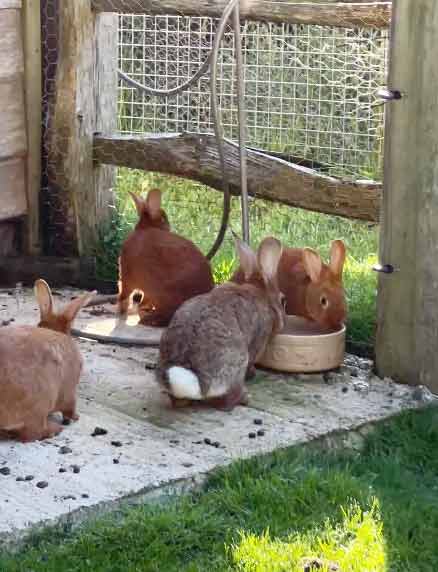
Perhaps the most important benefit, especially for a pet rabbit, lies in the way that these rabbits interact with their human companions.
Interacting With Rabbits
When you keep a rabbit in a cage, you need to pull it out of the cage in order to interact with it. Essentially you are bringing the rabbit into your world and interacting with it on your terms.
When you keep rabbits in a colony, you go into their environment, their territory, and interact with them on their terms.
There is a whole world of difference here, and I have no doubt at all, that interacting with people on their terms, is a much less stressful experience for the rabbit.
Social Contact
Off the top of my head, I cannot think of another highly social domestic animal that is routinely kept apart from other members of their species.
I don’t think many people would argue that social animals need access to others of their kind.
It seems so obvious to me and I think to most of us, that isolating rabbits from other rabbits is not to their benefit. But it’s something we humans have been doing for a very long time and old habits die hard.
Natural Behavior
Experts are increasingly emphasising the importance for captive animals to have the freedom to express natural behavior. The right to this freedom is gradually being made a legal requirement for captive animals in many parts of the world.
As a prey species, a wild rabbit needs to be an athlete in order to survive. Running at extreme speeds and turning impossibly fast are the wild rabbit’s only means of survival. And these are skills that need muscle power and practice.
Every instinct in a rabbit’s body tells them that this practice is important. This is why young rabbits, and older ones too, bink and twist and turn, to work those muscles and make sure they are ready for the day that their life depends on it. This is natural behavior for a rabbit.
A rabbit in a cage is unable to carry out this behavior. Of course a rabbit in a cage doesn’t need those skills, and that athletic prowess, but I suspect the rabbit doesn’t know that. Don’t you?
Benefits to you
The advantages of keeping rabbits in colonies don’t end with benefits to the rabbits. There are benefits to you too.
Where rabbits are pooping and peeing outside on grass, much of this waste is dealt with naturally by worms and beetles. You’ll still need to clean out their night quarters, but the workload of pen cleaning is reduced.
However, the main benefit to you is the pleasure that watching rabbits interact in a more natural environment brings.
Several members of our family work on our property during the week and the rabbit colony is where we all come for our coffee breaks.
Rabbits are extremely curious and will come up to us to see what we are doing and whether or not we have brought any treats for them.
It is such a relaxing and rewarding place to be.
I hope you are able to keep your rabbits in an area where you can join them and relax with them. It’s really one of the best ways to spend some time!

Free Rabbit Updates!
Get rabbit tips, news, reviews and the latest from Just A Few Rabbits, delivered to your inbox


