
Rabbits As Food – The Ethics And Practicalities Of Eating Rabbit Meat

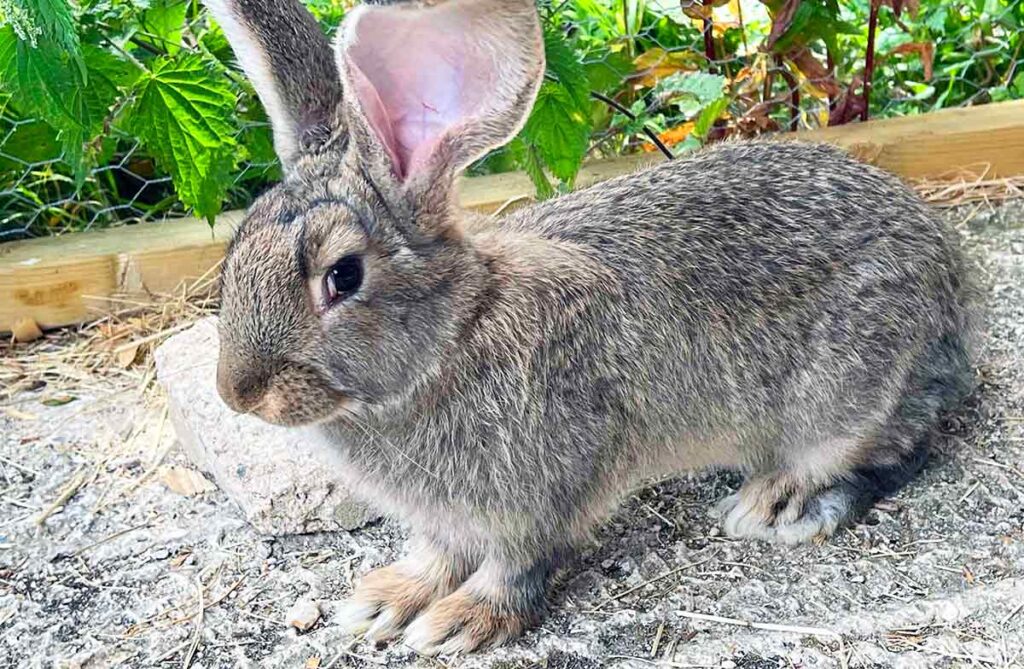
In this article I’m going to explain why we switched from chicken to rabbit as our main source of white meat, and look at some of the welfare issues surrounding both rabbits and chickens being produced for food.
Domestication For Food And Fur
The European Rabbit was originally domesticated as a source of meat and fur. Rabbit is a white meat very similar to chicken. And it was an extremely popular food source here in the UK up until after the second world war. Many ordinary folk had a rabbit hutch in their backyard and raised rabbits as food in much the same way as homesteaders raise chickens for meat now.
All the domestic rabbit breeds we have today are European Rabbits (Oryctolagus Cuniculus), a species that still thrives in the wild, although populations have taken a big hit in the last few decades due to Rabbit Viral Hemorrhagic Disease (RVHD).
Before RVHD took hold, wild rabbits were shot, trapped and snared in large numbers both as a food source, and as a means to try to limit the populations of these fast breeding, crop eating, animals.
The Decline In Popularity Of Rabbit Meat
In the latter part of the twentieth century, the popularity of rabbit as food started to fall. The ravages of myxomatosis, and the sight of horribly diseased rabbits dying in the countryside may have put people off eating rabbit. Together with the falling price of chicken as factory farming enabled poultry to be mass produced.
At the same time, rabbits grew in popularity as pets. And dare I say, our increasingly urbanised population grew more detached from the process of food production, and uncomfortable with the idea of eating an animal that they were familiar with.
Meat became something you purchased in a shop wrapped in cling film. And rabbits became thought of in the same way as cats and dogs. Pets and not food.
Unfortunately, the shift in role from food to pet for rabbits, was not accompanied by a shift in attitude towards rabbit welfare, and rabbits continued, and continue today, to be kept in largely unsuitable conditions for active, social mammals.
The Problem With Commercially Produced Meat
Of course rabbits didn’t stop being a source of meat when people stopped keeping meat rabbits in their backyards. Commercial rabbit production didn’t go away. Though it is less common in countries where the demand for rabbit meat has fallen.
In some countries today, rabbit meat is still a very important source of cheap, healthy meat. Unfortunately, to produce the cheapest meat, you need to pack the largest number of animals possible into a given space. And just like the cheap chicken we can now buy from our local stores, cheap rabbit meat comes at a heavy price for the animals that produce it.
Meat rabbits are generally kept in wire cages no more than 36 inches long. The cages have wire floors so that droppings and urine fall through to a collection area below. The rabbits are unable to run, jump or socialize with other rabbits.
Many homesteaders today, also keep their rabbits in these conditions, although they wouldn’t dream of keeping chickens this way.
So I think we have a way to go before rabbit welfare catches up with poultry welfare in the homesteading community. And one of the things I want to do with this website, is to show that it is possible to harvest meat from rabbits without turning them into battery chickens.
When we first moved to our homestead, our aim was to produce all of our own meat and most of our own vegetables. Both to improve the welfare of the animals we eat, and to reduce our carbon footprint.
We started by keeping both meat rabbits and meat chickens, but now all of our white meat comes from rabbit. And we only keep chickens for their eggs. So why the change?
Chicken Vs Rabbit: Meat Quality
The first reason is the quality of the meat. The chickens that you buy from the store are a specific type of chicken. They are distinctly different from the chickens that are raised for their eggs. In the USA they are usually a breed called the Cornish Cross. And in the UK, the similar Ross or Cobb chickens are favored.
These chickens grow exceptionally fast, more than twice as fast as a heritage breed of chicken. That means you can harvest them at just 8 weeks old when the meat is still very tender.
We did not want to raise these fast growing birds because of the welfare implications (more of that below) so we chose a very fine and tasty breed of chicken called the Dorking. These birds were far too small to eat at 8 weeks, and we harvested them at 12 weeks by which time the meat in the legs was distinctly tougher than the equivalent factory farmed bird.
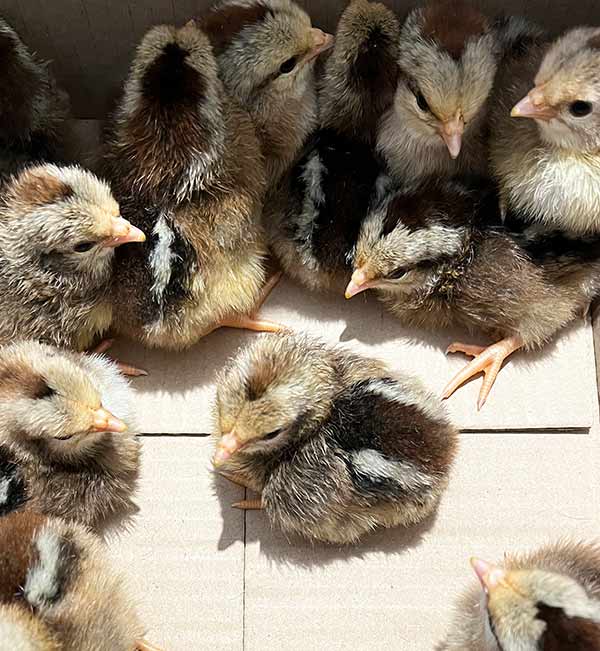
This wouldn’t matter so much if the breasts on these birds had not been so tiny. Less than a third the size of the breast on the same weight of store bought bird. Basically these birds were all leg, and the legs were tough.
Our rabbits on the other hand are still tender at ten weeks when they are big enough to harvest, and as we breed slightly bigger rabbits that age will come down.
Rabbit Vs Chicken: Raising & Processing
You can allow hens to hatch and raise their own chicks. But it’s a bit of a hit and miss affair. So it’s usually best to take the fertile eggs, incubate them and then raise them in a heated brooder until it is warm enough for them to go outside. Female rabbits on the other hand, are brilliant mothers, and take care of the whole raising and weaning process for you.
It takes just a couple of minutes to process a freshly killed rabbit for the larder. Chickens are a whole different ball game.
You need to set up a cauldron of almost boiling water to dip the freshly killed bird. This is essential to loosen the feathers. You then need to pluck the bird. We bought a feather plucker which helped, though it regularly broke down and needed unblocking.
The feathers make a huge mess and there’s a lot of water involved! That’s before you even start removing the internal organs.
Processing chickens is a smelly, biohazardous process, and simply a lot more unpleasant than processing a rabbit. Which might be worthwhile if the end result were better. But in our view it isn’t. Then there are the welfare issues.
Chickens Vs Rabbits: Accommodation & Welfare
In my view, chickens and rabbits have similar needs when it comes to housing. I don’t like to see either in tiny cages, and I think they are happiest in spacious pens with access to pasture.
Chickens are easier to contain. Rabbits, especially female rabbits, dig. And so they need an outdoor pen that takes this into account. That means mobile pens, also known as rabbit tractors or chicken tractors, have to be built with a floor that has mesh or wooden rails across it. Which really adds to the weight, making the pen difficult to move, and reduces access to grass.
When it comes to turning grass into meat, the rabbit leaves the chicken standing. Chickens do eat some grass, but mainly they just damage it. Rabbits on the other hand eat grass and turn it into meat very efficiently.
Getting meat is the whole point and with rabbits, some of the meat breeds are the healthiest rabbits you’ll find. They are big but not too big. And have none of the health issues associated with dwarfism in the smaller breeds.
The best meat chickens, the Cornish Cross and the Cobb on the other hand, are some of the unhealthiest birds you’ll ever meet. Breeding for huge breasts has pushed their legs too far apart, and these may break or give way under their own body weight. And their rapid growth has caused a raft of other health issues including heart problems.
Homesteaders frequently buy these birds and try to raise them beyond 8-10 weeks in the hopes of breeding their own stock. Typically these birds do not survive and they certainly are not capable of breeding, so you have to buy in new chicks each year.
For all these reasons, and more, we have switched much of the white meat in our family diet from chicken to rabbit.
Your Line In The Sand
For people who don’t want to eat meat there is no moral dilemma here. ‘No meat’ is their line in the sand. They don’t have to choose between chicken and rabbit. Or between farmed meat and hunted meat.
But for the rest of us, I believe it’s no bad thing to give some thought to where our meat comes from.
My personal preference is to eat meat from animals that have had a good life, long or short, and a humane death. That means we eat wild hunted meat such as venison. And meat that we raise here on our homestead.
In the past we also ate wild hunted rabbits. Sadly, now, here in the UK and much of Europe the wild rabbit population has been severely reduced by disease, and so domestic rabbit is a better option. In my view it also tastes better but that’s a personal thing.
And when it comes to rabbits, welfare standards vary widely, but they are often very poor. Not because the people keeping them are cruel, but rather because they are following widely accepted standard practices. The situation for pet rabbits is often not much better.
It’s those practices that I’d like to see changed. I think that will take time and will need people to share their own experiences of raising rabbits in colonies or with better housing conditions. That’s one of the reasons I decided to share our rabbit adventures with the world, and wherever your line in the sand lies, I hope you enjoy them!
Free Rabbit Updates!
Get rabbit tips, news, reviews and the latest from Just A Few Rabbits, delivered to your inbox